The movement of aiding the Republic by
the Soviet Union have many criticits, but the most of the students of
this period reach the same position, the moral superior of the USSR.
In the beginning of the conflict the
public opinion impulse a campaign of solidarity that moved people of
the worldwide.Declassified records and documents shows how the
surrounding of the USSR in the Republic change the movement of all
the world to close the influence of the communist in Spain. This
became official when the Soviet Union declare to fight for the rights
of the Republic, this make that this internacional aid decreased from
18 million francs to only aid of USSR. The Comitern also tried to get
influence in Spain after the war to move the masses, like what
happens in France with the Popular Front (supported by USSR).
The Comitern inicieted a conference in
Paris at the end of October to organize practival relief for the
Spanich women, children and families, which has a propaganda
operation within trying to move the internacional proletariat and
democratic forces of all states, developing an activism of brotherly
to the Spanish people.
In spite of all of this tries, six
months of war the ECCI suggested to intervention to explote all the
posibilities.
Many measure were token by the sovietic
government to move all the country, but one curious term of the aid
part said that:
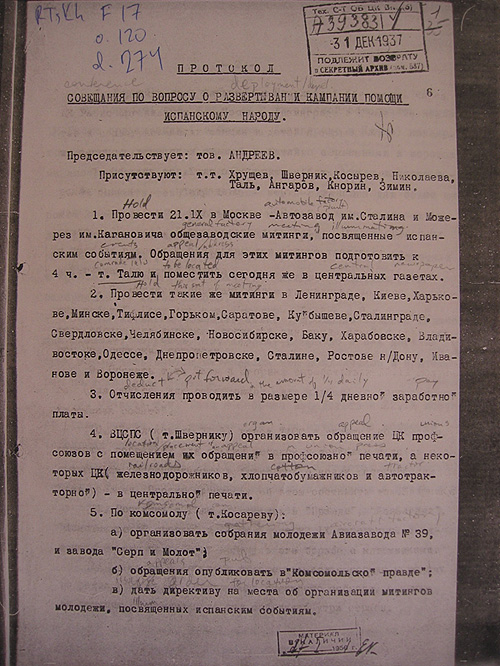 “ a.Aim
of the campaign:
“ a.Aim
of the campaign:The aim of the campaign is to put a stop to the aid being rendered Franco.
Forms of the Campaign:
- In non-fascist countries: mass meetings, meetings at factories, demonstrations, action in Parliament, municipalities and in the Labor press.
- In fascist countries: all forms of protest no matter how insignificant they may seem at times—chalking walls, pasting up small placards, scattering leaflets at places where large numbers of people gather, i.e. market places, theatres, cinemas; small flying meetings, utilization of the illegal radio, open letters of relatives of soldiers serving in Spain, organizing the expression of sympathy with them, etc.
Everywhere, both in fascist and non-fascist countries, collections should be organized at the factories.... ”
This catch the intention of the
sovietic, that wanted a feedback of the war and of the all
invesments.
In the Red Square there were many
demostrations defended the Spanish Republic, orators, speeches,
singing, chanting and declarations of some revolutionaries.This
demostrations spread out to many Sovietic cities.
----------------------------------------------------------------------------------------------------------------------------------------------
----------------------------------------------------------------------------------------------------------------------------------------------
The Soviet Union provided the Republican side with many weapons and vehicules, In one hand, many of them were obsolete or too old related to the National side weapons and aircraft. In the other hand, their tanks were better than the german tanks.
I-15:

I-16:

SB-Tupolev:

The Soviet Union profited from the international isolation
of the Spanish Republic imposed by the Non-intervention
agreements and assisted the beleaguered Republican government by providing
weapons and pilots. Russians pilots were volunteers. They received no
incentives, like combat bonuses.
After the western democracies refused military
assistance to the established Spanish Government in the name of so-called
"Non-Intervention", the Soviet Union and Mexico were practically the only
nations that helped Republican Spain in its struggle. Hitler and Stalin saw the first war
experience in Spain,
testing its new technics and advances.
 The first planes that came to Spain were Tupolev SB bombers.
Their first action was a morale-lifting bombing raid on Talavera
de la Reina military airfield used by the Legionary Nazi and Italian
planes. This action made the Russian pilots very popular among the people in
Madrid.
The Katiuska pilots took advantage for the time being of their
aircraft's relatively higher speed, but the plane was vulnerable and its fuel
tanks easily caught fire when shot at.
The first planes that came to Spain were Tupolev SB bombers.
Their first action was a morale-lifting bombing raid on Talavera
de la Reina military airfield used by the Legionary Nazi and Italian
planes. This action made the Russian pilots very popular among the people in
Madrid.
The Katiuska pilots took advantage for the time being of their
aircraft's relatively higher speed, but the plane was vulnerable and its fuel
tanks easily caught fire when shot at.
Sergei Fyodorovich Tarkhov was one of the first Russian
fighter pilots reaching Spain
along with the new Russian Chato and Moscaplanes in October 1936.
Very quickly Tarkhov distinguished himself by claiming five victories against
the Junkers Ju 52 Nazi planes that dropped bombs over Madrid. But this young and enthusiastic
pilot's plane was shot down on 13 November 1936. Tarkhov died from his wounds
one week later at the Gómez Ulla Military
Hospital in Madrid and a Squadron, Escuadrilla
Tarkhov, was named in his honor.
There were about 300 Russian pilots in or around Madrid by the end of
November 1936. The improved defensive capacity of the Spanish
Republic boosted the morale of the
areas of Spain
under loyalist control. The Russian pilots gave their best performance in the Battle
of Guadalajara, routing the Italian Aviazione Legionaria and
pounding the Fascist militias incessantly from the air.
Following the demands of the Non-Intervention Committee,
Soviet pilots were phased out in the fall of 1938 and trained Spanish airmen
took their places after having been trained at the flying schools of Albacete, Alicante,Murcia, El Palomar, Alhama, Los
Alcázares, Lorca or El Carmolí that had been set up by the Soviet military.
From about 772 Russian airmen that served the Spanish Republican Air Force for
over two years, a total of 99 lost their lives.
…............................................................................................................................................................
The USSR
contravened the League of Nations boicot by
providing material assistance to the Republican forces, becoming their only
source of major weapons. Unlike Hitler and Mussolini, Stalin tried to do this
covertly. In total, estimates of material provided by the USSR to the
Republicans vary between 634-806 planes, 331-362 tanks and
1,034-1,895 artillery pieces.
Stalin also created Section X of the Soviet Union military to head the weapons shipment
operation, called Operation X. Despite Stalin's interest in aiding the
Republicans, the quality of arms was inconsistent. On one hand, many of the
rifles provided were old, obsolete or otherwise of limited use. On the other
hand, the T-26 and BT-5 tanks were modern and effective in combat. The Soviet
Union supplied aircraft that were in current service with their own forces, but
the aircraft provided by Germany
to the Nationalists proved superior by the end of the war.
The Republic paid for Soviet arms with official Bank of
Spain gold reserves. This would later be the frequent subject of Franquist
propaganda, under the term "Moscow Gold". The cost of the Soviet
Union arms was more than the value of Spain's gold reserves, the fourth-largest
in the world, estimated at US $500 million (1936 prices), 176 tonnes of which
was transferred through France.
The USSR sent a number of military advisers to Spain
and, while Soviet troops were fewer than 500 men at a time, Soviet volunteers
often operated Soviet-made tanks and aircraft, particularly at the beginning of the war.In
addition, the Soviet Union directed Communist parties around the world to
organize and recruit the International Brigades.
Another significant Soviet involvement was the activity of
the People's Commissariat for Internal Affairs (NKVD) inside the Republican
rearguard. Communist figures including Vittorio Vidali ("Comandante
Contreras"), Iosif Grigulevich, Mikhail Koltsov and, most prominently,
Aleksandr Mikhailovich Orlov led operations that included the murders of
Catalan anti-stalinist Communist politician Andreu Nin and independent
left-wing activist José Robles. Also, the shooting down in December 1936 of the
French aircraft in which the delegate of the International Committee of the Red
Cross (ICRC),Georges Henny, carried to France extensive documentation on
the Paracuellos massacres was a NKVD-led operation.
Las tropas del coronel Asensio fueron objeto de un intenso bombardeo de la
aviación republicana dirigida por André Malraux; Una sección de esta unidad fue
casi destruida en Medellín. Este ataque retrasó seriamente las operaciones, ya que
a los sublevados cogió por sorpresa este ataque y no disponían de medios aéreos
para hacer frente.
Esta era la primera actuación importante de la conocida como Escuadrilla
España, una unidad formada por André Malraux en Francia con unos pocos
pilotos y que reunía a tres bombarderos Potez, dos Breguet y un Douglas
reconvertido a bombardero.Aun así, estos aviones no estaban preparados para la
guerra moderna (las bombas debían lanzarse por las ventanas de los aparatos)


No hay comentarios:
Publicar un comentario