Land forces.


Air Forces.
The Spanish Civil War was, in so many aspects, an experimental war. The big foreign powers like Germany, Italy or the Soviet Union used this war like a battlefield to test their new weapons.
This
group were composed initially by a few anti-aircraft cannons,
anti-tanks cannons and four Panzer I. Those anti-aircraft cannons were
used to defend the nazis airports and protect the land divisions. This
divisions were commanded by von Thoma, a famous tank leader during the WWII, who used innovative tactics and strategies.
Following German recognition of Franco's government on 30 September of
1936, German efforts in Spain were reorganised and expanded. The existing command structure was replaced with the Winterübung Rügen, and the military units already in Spain were formed into a new legion, which was briefly called Iron Rations (German: Eiserne Rationen) and Iron Legion (German: Eiserne Legion) before Göring renamed it as the Condor Legion.
The first German chargé d'affaires
to Franco's government in 1936, General Wilhelm von Faupel arrived in
November, but was told not to interfere in military matters.

Panzer I.
The Panzer I tanks were totally worst against the sovietic T-26 tanks, in spite of the 200 tanks that were sent.

T-26.
Von
Thoma said to the Americans (after the WWII) that he had participated
in 192 war actions in the Spanish conflict. Another important military
piece sent from the Germans (either air or land) were the use of the 88
mm Flak 18 cannons. This weapon was very useful during the conflict and
participated into the Second World War too, with the same effectiveness.

Flak 18. (antitank & antiaircraft cannon)
In conclusion, the German land logistic support was essential to the Nationalist victory.
----------------------------------------------------------------------------------------------------------------------------
Air Forces.
The Spanish Civil War was, in so many aspects, an experimental war. The big foreign powers like Germany, Italy or the Soviet Union used this war like a battlefield to test their new weapons.
The war provided combat experience with the latest technology for the German military. Germany
sent the Condor Legion, composed with volunteers from his Air Force
(Luftwaffe). His official mission was support to the Nationalism Band
during his campaings over the war. It was the first time in which the
Air Force were
used like a main offensive force. They tested bombers like
the Heinkel 111, Ju 87 or the Dornier Do-17.
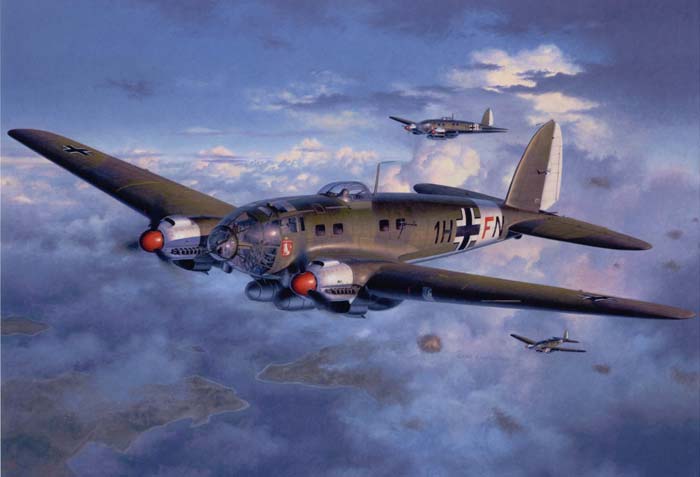
Heinkel 111 (strategic bomber)

Ju-87 (also know Stuka; dive bomber)

Do-17 (strategic bomber)
With this class of
bombers they developed new war tactics like "the carpet
bombing", which is a large aerial bombing done to inflict damage in all selected area of land.
The
most important example of this tactic was the "Guernica bombing", when
two Heinkels He 111, one Dornier Do 17, eighteen Ju 52 and three Italian
SM.79 bombered 22 tonnes of explosive bombs over Guernica. The bombing
is considered one of the first raids on a defenceless civilian
population by a modern air force. The Basque government reported 1,654
people killed. This bombing hadn't got any tactical implication. It
wasn't a important republican settlement. Hermann Goering also confessed
in 1946 that Germany had considered Guernica as a testing ground.

Guernica's view after the bombing.

Ju-52 (bomber version)
It
is particular, between the german aircraft, the Ju-87's case. The first
time, one model was introducing secretly into Spain in 1936. It
participates in the National Offensive over Bilbao and then it returned
to Germany. Later, more Stukas were sent discretly to Spain and they
participates in the Catalonia Offensive. They realised anti-shipping
missions. Two of them were taking down, one came down and the other
landing on a beach without crash.

Stuka taken down.
The experience of the Spanish Civil War was so much important. The air and
ground crews perfected their skills, and equipment was evaluated under
combat conditions, although they didn't participate against a well-coordinated fighter opposition.
In conclusion, the Germany Air Force used Spain like a testing ground for his Luftwaffe.

No hay comentarios:
Publicar un comentario