sábado, 14 de noviembre de 2015

Corpo Truppe Volontarie (CTV)

The Corps of Volunteer Troops was an expeditionary force from the Fascist Italy, sent to Spain on 1936 in order to support the Nationalist forces during the Spanish Civil War.
At the beginning of the war, most of the Nationalist forces were isolated in Morocco and the Canary Islands, with the Spanish Army and its airforce supporting the republican government. With this situation, Franco had to ask for help in Germany and Italy, sending Hitler and Mussolini transport aircraft and crews to airlift the Nationalists from Morocco to Spain.
L3/35, also named as Carro Veloce CV-35 (light tank)
The Corpo Truppe Volontarie was divided into 4 divisions:
-4th Infantry Division “Littorio” (Lictor): was a fully motorized Infantry division of the Italian Royal Army (Regio Esercito).
-1st Blackshirt (Camicie Nere, or CCNN) Infantry Division “Dio lo Vuole” (“God wants it”).
-2nd Blackshirt Infantry Division “Fiamme Nere” (“Black Flame”).
-3rd Blackshirts Infantry Division “Penne Nere” (“Black Feathers”).
With the final Nationalist victory, the Italians had a friendly regime in the western Mediterranean, but at a high cost. Of the 78,500 men sent to Spain, between 3,000 and 4,000 aproximately were killed, and around 12,000 of them were wounded. Also, they had a big lost of war material, and the intervention of Italy in this war supposed a great finantial cost (between 6 and 8,5 billion lire). In conclussion, the Mussolini's intervention in the Spainish Civil War handicapped Italy in the period leading up to World War II.

Batalla de Málaga entre el 3 y el 8 de febrero de 1937.

Esta batalla supuso una victoria decisiva del bando nacionalista, con la colaboración del Corpo Truppe Volontarie y de los regulares marroquíes, para acabar con el control del bando republicano sobre la provincia de Málaga. El bando republicano contaba únicamente con 12,000 soldados (8,000 de ellos armados), con escaso entrenamiento, poca munición y poca disciplina; aún así, contaban con el apoyo de los campesinos de la zona. El bando nacionalista contaba con 15,000 regulares abundantemente armados; 10,000 soldados pertenecientes a los camisas negras, divididos en 9 batallones mecanizados, equipados con abundante artillería, tanques ligeros CV-35 y carros blindados; además, contaban con 100 aviones de la Aviación Legionaria y 4 cruceros de la Armada Nacional.

Tres batallones nacionalistas, dirigidos por Francisco de Borbón y de la Torre (Duque de Sevilla), iniciaron el asalto de Málaga por el oeste en Ronda el 3 de febrero. A esto le siguió la ofensiva mecanizada de los camisas negras por el norte de la ciudad de Málaga en la noche del 4 de febrero, logrando un gran avance gracias a que los republicanos no estaban preparados para una guerra acorazada. Los nacionalistas siguieron con su firme avance hacia Málaga hasta llegar a la ciudad el día 6; con ello, los republicanos ordenaron la evacuación de la ciudad. Los civiles y milicianos que huían por la carretera de Almería fueron atacados por aviones italianos, provocando una gran masacre.

 
Huida de civiles por la carretera de Málaga.

Tras la caída de Málaga, los republicanos que no lograron huir fueron encarcelados o ejecutados (ejecutándose hasta a 4,000 republicanos), y muchos de los que huyeron por la costa murieron.
Esta victoria supuso un gran triunfo para los italianos, aunque sus graves carencias quedaron al descubierto en la Batalla de Guadalajara, al sufrir una rotunda derrota ante el experimentado Ejército Popular republicano.


viernes, 13 de noviembre de 2015

Aviazione Legionaria (Italian Legionary Air Force)

The Aviazione Legionaria was an expeditionary corp from the Fascist Italy, which helped to the pro-Fascist band during the Spanish Civil War. It was the Italian equivalent of the German Condor Legion. It served since 1936 to 1939, with its base in Majorca, Balearic Islands.

Instead Francisco Franco tried to convince Benito Mussolini to send him aircraft support, Mussolini denied it, but the pressure of Galeazzo Ciano changed his mind and he sent him thirty fighter planes.


Savoia-Marchetti SM.81 Sparviero (bomber, transport)
Fiat G.50 Freccia Arrow (fighter)
Fiat BR.20 Cicogna (bomber)
Breda Ba.65 (attacker)
Later, Italy sent 12 Sparvieros with some experimented crew. This would be the first unit, known as Aviación del tercio. The crews were provided with civilian clothes and fake documents, and the aircraft symbols were blotted because they wanted to prevent an international incident with the pro-Republican European governments.
Not all these airplanes came to their destiny; two of them, because of some bad cicumstances, crashed or did an emergency landing before arrived at the Nationalist Spainish territories in Morocco.

Bombing of Barcelona on March 1938

This was one of the most important operations of this corp during the Spanish Civil War.
On 15 March 1938, the French government decided to reopen its frontier with Spain, so the Soviet supplies begun to pass to Barcelona; this supposed the decission of Mussolini to carry out a massive bombing against this city. There were 17 raids by the Italian Sparvieros bombers at three hours intervals between 16 and 18 March. The only opossition to these raids was a little anti-aircraft artillery, with no fighter cover until the morning of 17 March. This attack supposed the throw of 44 tons of bombs by the Aviazione Legionaria and the death of more than 1000 civilians, between other damages.

sábado, 7 de noviembre de 2015

The Russian Aircraft and Aid


 The Soviet Union provided the Republican side with many weapons and vehicules, In one hand, many of them were obsolete or too old related to the National side weapons and aircraft. In the other hand, their tanks were better than the german tanks.


I-15.


I-16.


SB-Tupolev.


The Soviet Union profited from the international isolation of the Spanish Republic imposed by the Non-intervention agreements and assisted the beleaguered Republican government by providing weapons and pilots. Russians pilots were volunteers. They received no incentives, like combat bonuses.

After the western democracies refused military assistance to the established Spanish Government in the name of so-called "Non-Intervention", the Soviet Union and Mexico were practically the only nations that helped Republican Spain in its struggle. Hitler and Stalin saw the first war experience in Spain, testing its new technics and advances.

The first planes that came to Spain were Tupolev SB bombers. Their first action was a morale-lifting bombing raid on Talavera de la Reina military airfield used by the Legionary Nazi and Italian planes. This action made the Russian pilots very popular among the people in Madrid. The Katiuska pilots took advantage for the time being of their aircraft's relatively higher speed, but the plane was vulnerable and its fuel tanks easily caught fire when shot at.

Sergei Fyodorovich Tarkhov was one of the first Russian fighter pilots reaching Spain along with the new Russian Chato and Moscaplanes in October 1936. Very quickly Tarkhov distinguished himself by claiming five victories against the Junkers Ju 52 Nazi planes that dropped bombs over Madrid. But this young and enthusiastic pilot's plane was shot down on 13 November 1936. Tarkhov died from his wounds one week later at the Gómez Ulla Military Hospital in Madrid and a Squadron, Escuadrilla Tarkhov, was named in his honor.

German Ju-52

There were about 300 Russian pilots in or around Madrid by the end of November 1936. The improved defensive capacity of the Spanish Republic boosted the morale of the areas of Spain under loyalist control. The Russian pilots gave their best performance in the Battle of Guadalajara, routing the Italian Aviazione Legionaria and pounding the Fascist militias incessantly from the air.

Following the demands of the Non-Intervention Committee, Soviet pilots were phased out in the fall of 1938 and trained Spanish airmen took their places after having been trained at the flying schools of Albacete, Alicante, Murcia, El Palomar, Alhama, Los Alcázares, Lorca or El Carmolí that had been set up by the Soviet military. From about 772 Russian airmen that served the Spanish Republican Air Force for over two years, a total of 99 lost their lives. 

…............................................................................................................................................................

The USSR contravened the League of Nations boicot by providing material assistance to the Republican forces, becoming their only source of major weapons. Unlike Hitler and Mussolini, Stalin tried to do this covertly. In total, estimates of material provided by the USSR to the Republicans vary between 634-806 planes, 331-362 tanks and 1,034-1,895 artillery pieces.

Stalin also created Section X of the Soviet Union military to head the weapons shipment operation, called Operation X. Despite Stalin's interest in aiding the Republicans, the quality of arms was inconsistent. On one hand, many of the rifles provided were old, obsolete or otherwise of limited use. On the other hand, the T-26 and BT-5 tanks were modern and effective in combat. The Soviet Union supplied aircraft that were in current service with their own forces, but the aircraft provided by Germany to the Nationalists proved superior by the end of the war.

 T-26.

BT-5 (and an I-16)

The Republic paid for Soviet arms with official Bank of Spain gold reserves. This would later be the frequent subject of Franquist propaganda, under the term "Moscow Gold". The cost of the Soviet Union arms was more than the value of Spain's gold reserves, the fourth-largest in the world, estimated at US $500 million (1936 prices), 176 tonnes of which was transferred through France.
The USSR sent a number of military advisers to Spain and, while Soviet troops were fewer than 500 men at a time, Soviet volunteers often operated Soviet-made tanks and aircraft, particularly at the beginning of the war. In addition, the Soviet Union directed Communist parties around the world to organize and recruit the International Brigades.


Another significant Soviet involvement was the activity of the People's Commissariat for Internal Affairs (NKVD) inside the Republican rearguard. Communist figures including Vittorio Vidali ("Comandante Contreras"), Iosif Grigulevich, Mikhail Koltsov and, most prominently, Aleksandr Mikhailovich Orlov led operations that included the murders of Catalan anti-stalinist Communist politician Andreu Nin and independent left-wing activist José Robles. Also, the shooting down in December 1936 of the French aircraft in which the delegate of the International Committee of the Red Cross (ICRC), Georges Henny, carried to France extensive documentation on the Paracuellos massacres was a NKVD-led operation.

Batalla de la Sierra Guadalupe:
Las tropas del coronel Asensio fueron objeto de un intenso bombardeo de la aviación republicana dirigida por André Malraux; Una sección de esta unidad fue casi destruida en Medellín. Este ataque retrasó seriamente las operaciones, ya que a los sublevados cogió por sorpresa este ataque y no disponían de medios aéreos para hacer frente.

Esta era la primera actuación importante de la conocida como Escuadrilla España, una unidad formada por André Malraux en Francia con unos pocos pilotos y que reunía a tres bombarderos Potez, dos Breguet y un Douglas reconvertido a bombardero. Aun así, estos aviones no estaban preparados para la guerra moderna (las bombas debían lanzarse por las ventanas de los aparatos)


miércoles, 28 de octubre de 2015

What did the germans learnt during the Spanish Civil War? (Luftwaffe, first part)

The Spanish Civil War was, in so many aspects, an experimental war. The big foreign powers like Germany, Italy or the Soviet Union used this war like a battlefield to test their new weapons.

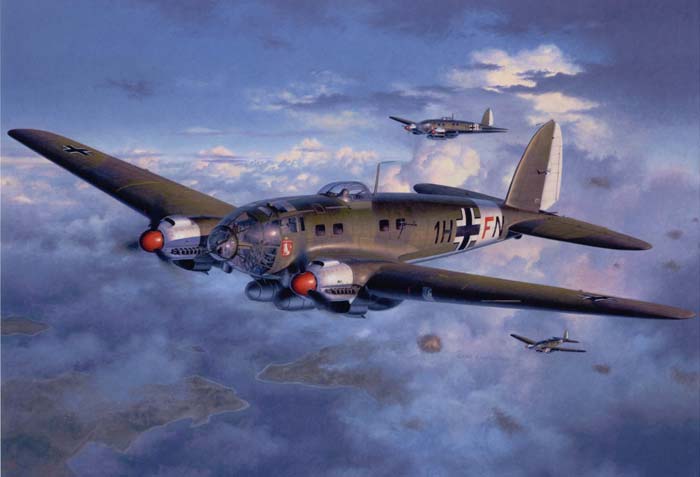
The war provided combat experience with the latest technology for the German military. Germany sent the Condor Legion, composed with volunteers from his Air Force (Luftwaffe), lands forces and naval forces. In this first part I will expose about the aerial forces. His official mission was support to the Nationalism Band during his campaings over the war. It was the first time in which the Air Force were used like a main offensive force. They tested bombers like the Heinkel 111, Ju 87 or the Dornier Do-17. 


 Heinkel 111 (strategic bomber)

Ju-87 (also know Stuka; dive bomber)

Do-17 (strategic bomber)

With this class of bombers they developed new war tactics like "the carpet bombing", which is a large aerial bombing done to inflict damage in all selected area of land. 

The most important example of this tactic was the "Guernica bombing", when two Heinkels He 111, one Dornier Do 17, eighteen Ju 52 and three Italian SM.79 bombered 22 tonnes of explosive bombs over Guernica. The bombing is considered one of the first raids on a defenceless civilian population by a modern air force. The Basque government reported 1,654 people killed. This bombing hadn't got any tactical implication. It wasn't a important republican settlement. Hermann Goering also confessed in 1946 that Germany had considered Guernica as a testing ground. 

 Guernica's view after the bombing.

Ju-52 (bomber version)

It is particular, between the german aircraft, the Ju-87's case. The first time, one model was introducing secretly into Spain in 1936. It participates in the National Offensive over Bilbao and then it returned to Germany. Later, more Stukas were sent discretly to Spain and they participates in the Catalonia Offensive. They realised anti-shipping missions. Two of them were taking down, one came down and the other landing on a beach without crash.

They improved his bombing tactics with this plane using this type of maneuver.

Stuka's maneuver.

 
Stuka taken down.

The experience of the Spanish Civil War was so much important. The air and ground crews perfected their skills, and equipment was evaluated under combat conditions, although they didn't participate against a well-coordinated fighter opposition.


In conclusion, the Germany Air Force used Spain like a testing ground for his Luftwaffe.